Choosing between diamond and carbide bits is one of the most expensive decisions a stone workshop makes. Choose well, and your engraving stays sharp, your tools last, and your cost per job stays low. Choose badly, and you burn through bits, chip edges and lose money on every slab.
At Kataria Tech Zone, we help workshops move from wood and acrylic into stone. Tooling questions come up in almost every conversation. This guide explains how diamond and carbide tooling differ, which one suits marble and which suits granite, and how to work out the real cost of each. It also covers the mistakes that ruin bits and finishes.
If you are still deciding whether to add stone work at all, start with our ultimate guide to CNC stone routing and come back here for the tooling detail.
Why Tooling Matters More in Stone Than in Wood
On a wood router, a dull bit gives a rougher edge. In stone, the tool is the most important variable after machine rigidity. Marble and granite are abrasive, and a bit that suits one can fail within minutes on the other.
The difference comes down to mineral hardness:
- Marble is mostly calcite, which is fairly soft (about 3 on the Mohs scale).
- Granite contains quartz and feldspar, which are much harder (about 6 to 7 on the Mohs scale).
Quartz grains wear away a cutting edge quickly. That single fact explains most of the tooling choices below.
What Is Carbide Tooling?
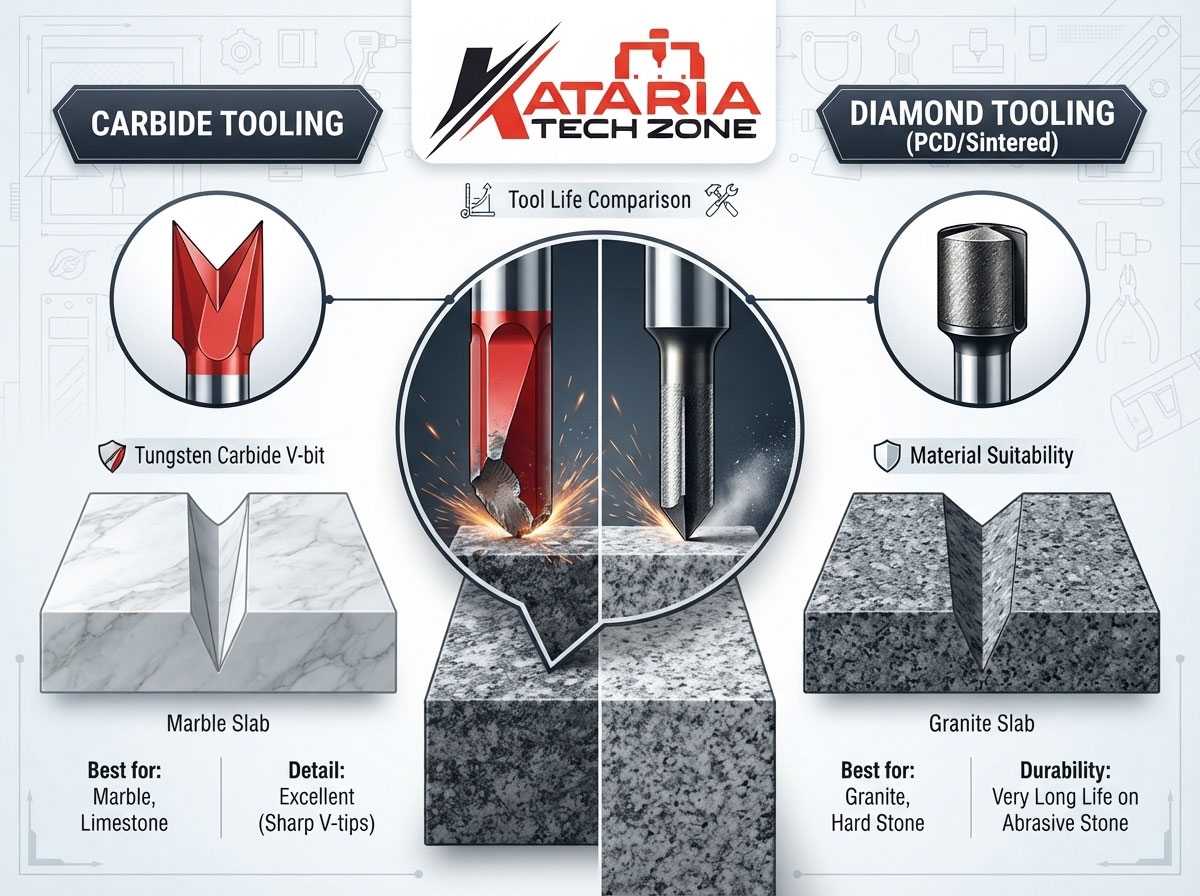
Carbide bits are made from tungsten carbide, a very hard material bonded with cobalt. In the stone trade you will often hear the term “Widia,” a brand name that has become shorthand for carbide tips. Common types include:
- V-bits (30°, 60°, 90°) for lettering and line work
- Ball-nose and round-tip bits for smooth relief and radiused detail
- Flat-tip bits for clearing background areas
Where carbide performs well
- Marble, limestone, travertine, onyx and other softer stones
- Fine lettering and sharp V-grooves
- Lower-volume and prototype jobs
- Workshops on a tighter tooling budget
Where carbide struggles
- Granite, quartz and other hard stones, where the edge dulls fast
- Long production runs, where frequent changes cost machine time
What Is Diamond Tooling?
Diamond is the hardest known material, so it cuts through quartz-rich granite without wearing away as quickly. Diamond tools come in three main forms.
1. PCD (polycrystalline diamond) bits
A solid layer of synthetic diamond is bonded to the tool tip. PCD bits are the usual choice for granite engraving and fine carving. They hold a sharp edge for a long time, but they cost the most upfront and can chip if dropped or mishandled.
2. Sintered (metal-bonded) diamond bits
Diamond grit is mixed into a metal matrix and formed into the bit. As the matrix wears slowly, fresh diamond is exposed, so the bit keeps cutting. They are a good all-rounder for granite and harder marbles.
3. Electroplated diamond bits
A single layer of diamond grit is bonded to the tool surface. They are inexpensive and cut freely, which makes them popular for marble and softer work. The layer wears out sooner than a sintered or PCD bit, so life is shorter.
Diamond vs. Carbide: Side-by-Side Comparison
| Factor | Carbide | Diamond (PCD / sintered) |
|---|---|---|
| Best for | Marble, soft stone | Granite, hard stone, and marble too |
| Upfront cost | Low | Higher |
| Tool life on granite | Short | Long |
| Tool life on marble | Good | Very long |
| Fine detail | Excellent (sharp V-tips) | Very good (depends on tool type) |
| Edge quality | Clean on soft stone | Clean on hard stone |
| Regrinding | Possible | Limited or not practical |
| Cooling need | Water strongly advised | Water essential |
| Best fit | Small workshops, mixed jobs | Production, hard stone, high volume |
Prices and tool life vary widely by brand and stone. Always check your tool maker’s specifications.
Marble Engraving: Which Tool Should You Choose?
For most marble work, carbide is the sensible starting point. Marble is soft enough that a good carbide V-bit gives crisp, clean lettering at a low cost per tool.
Choose carbide for marble when:
- You engrave nameplates, signage or decorative lettering
- You want the finest detail from a sharp V-tip
- You are testing the stone market and want low tooling risk
Choose diamond for marble when:
- You run high volumes and want fewer tool changes
- The marble is unusually hard or contains quartz veins
- You need consistent depth and width across many pieces
Electroplated diamond bits also work well on marble for relief and finishing passes. For deep or heavy production, sintered diamond usually lasts longer.
Granite Engraving: Why Diamond Is the Standard
Granite is where carbide tooling reaches its limit. The quartz in granite wears a carbide edge quickly, and once the edge dulls it stops cutting cleanly. The result is rough edges, pitting and a poor surface.
Use PCD or sintered diamond for granite. The higher price per bit is usually repaid through much longer life and steadier quality. For memorial work, nameplates and any job where a customer will inspect fine lettering, that consistency matters.
The Real Cost: Cost Per Job, Not Cost Per Bit
Many beginners compare tool prices and pick the cheapest. That is a mistake. A better method is to work out the tooling cost per metre of engraving or per finished job:
Cost per job = tool price ÷ number of jobs (or metres) the tool completes
Then add the hidden costs:
- Machine downtime for each tool change
- Rejected pieces caused by a worn tool
- Re-work and polishing time
- Slab cost when a job is ruined
A carbide bit that costs a fraction of a diamond bit but fails after a short run on granite can cost more per job. A diamond bit used on soft marble for simple lettering may be more tool than you need. Match the tool to the stone and the volume, and track actual tool life for a month. Your own numbers will beat any general rule.
Water Cooling: Not Optional
Both tool types need cooling, and diamond tools need it most. Heat breaks down the bond that holds the diamond, and it dulls carbide edges too.
Water also does a second job: it controls dust. Stone dust contains crystalline silica, which can cause serious, permanent lung disease when inhaled. Wet cutting, good extraction and a respirator are essential in any stone workshop.
Check that your machine has:
- A water tank or recirculation system with a steady, adjustable flow
- A water-cooled spindle suited to continuous work
- Sealed guides and bearings to keep slurry out of moving parts
Our range of CNC stone router machines is designed around these requirements. If you are not sure whether your current machine can handle stone, our guide on CNC routers versus traditional woodworking tools explains how machine build changes with the material.
Setting Up Your Cuts: Depth, Speed and Passes
Exact settings depend on your machine, spindle, stone and tool, so treat any number as a starting point and follow your tool maker’s guidance. These principles apply across the board:
- Take shallow passes. Fine engraving in marble and granite is often done in light passes, with deeper relief built up in stages rather than one heavy cut.
- Never plunge hard. Ramp in gently to protect the tool tip, especially with PCD.
- Keep the feed steady. Stopping the tool in the cut creates heat and burn marks.
- Match spindle speed to the tool. Diamond and carbide tools each have a recommended range.
- Test on an offcut first. A few minutes of testing costs far less than a ruined slab.
Common Mistakes That Destroy Bits and Finishes
- Cutting dry. This overheats the tool, damages the bond and creates dangerous dust.
- Using carbide on hard granite. The edge wears out fast and the finish suffers.
- Cutting too deep in one pass. This breaks tools and chips edges.
- Ignoring stone variation. Veins, fissures and quartz pockets in the same slab can behave differently. Slow down over them.
- Poor clamping. A slab that shifts even slightly ruins fine lettering and can snap a tool.
- Letting a worn bit keep running. A dull tool creates heat and rough edges. Replace or resharpen at the first sign.
- Weak machine rigidity. Vibration causes chatter and chipped detail no matter how good the bit is.
How to Extend Tool Life
- Keep water flowing at a steady, sufficient rate
- Inspect bits before each job, and look for chips, glazing or uneven wear
- Clean slurry and residue from the tool holder and collet
- Store diamond bits in protective cases
- Follow the tool maker’s dressing or break-in instructions for sintered bits
- Log tool hours and jobs so you can predict replacements
Which Tool Should Your Workshop Buy?
If you are just starting with marble: begin with quality carbide V-bits and ball-nose bits, plus one or two electroplated diamond bits for finishing. Learn the process before investing in premium tooling.
If you work mainly in granite: go straight to PCD or sintered diamond. Do not waste money on carbide for hard stone.
If you work in both: keep a small kit of each. Use carbide for marble lettering, and diamond for granite and high-volume marble.
If you serve temples and architecture: detailed relief on marble, sandstone and similar stone often suits carbide ball-nose and V-bits for detail, with diamond used where stone is harder. Our article on CNC stone routers in temple architecture covers this type of work.
Choosing the Right Machine to Match Your Tooling
Even the best diamond bit will underperform on a weak machine. When you evaluate a stone router, check for:
- A heavy welded frame that resists vibration
- A water-cooled spindle rated for continuous use
- Precision linear guides and drives for fine detail
- A proper water and slurry management system
- Software compatibility with your CAD/CAM workflow
At Kataria Tech Zone, we can help you match a machine, tooling and workflow to your budget and the stone you plan to cut. You can browse our full CNC router machine category, see our shop, or read more workshop guides on the Kataria Tech Zone blog. If you are new to CNC in general, start with Getting Started with CNC Routers for Woodworking.
Frequently Asked Questions
Can carbide bits engrave granite?
They can cut it, but the edge wears quickly because of the quartz content. For anything beyond a test cut, diamond tooling is the better choice.
Are diamond bits worth the higher price?
On granite and on high-volume work, usually yes, because longer life and consistent quality lower the cost per job. For occasional marble lettering, carbide is often enough.
What is the difference between PCD and sintered diamond bits?
PCD bits have a solid synthetic diamond tip and stay sharp for a long time. Sintered bits contain diamond grit in a metal matrix that wears gradually to expose fresh diamond. Sintered bits are often cheaper and more forgiving, while PCD suits precision work.
Do I need water when engraving stone?
Yes. Water cools the tool and controls hazardous silica dust. Dry cutting is unsafe and shortens tool life.
Can I use a wood CNC router for marble engraving?
Only in very limited cases. Most wood routers lack the rigidity, cooling and sealing that stone work demands. A dedicated stone router is the safer investment.
How do I know when a bit is worn out?
Signs include rough or chipped edges, burn marks, increased noise or vibration, and a visible loss of sharpness. Replace it rather than pushing through.
Final Thoughts
There is no single best tool for every stone job. Carbide gives you low-cost, sharp detail on marble. Diamond gives you durability and consistency on granite and in production. The smartest workshops match the tool to the stone, measure cost per job, cool everything properly and invest in a machine stable enough to use good tooling well.
If you are planning to expand into stone, talk to the team at Kataria Tech Zone. We can help you choose a CNC stone router and set up a tooling approach that fits your work. Visit katariatechzone.com to explore our machines and guides.